
How to create your first marketing budget (with examples)

Tis’ the season for calculator crunching—yup, that end-of-year budget bonanza we all know and love. Whether that’s December for you, or your fiscal year is yet to expire, it’s ALWAYS a good time to stay on top of the numbers. And while it’s not the hottest topic for us creative folk to cover, it is absolutely a necessary evil.
The elusive ✨ MARKETING BUDGET ✨
If you don’t have one, well… that’s probably why you’re reading this. Keep reading and we’ll give you all the essentials: why you need a marketing budget, how much moula to set aside, and how to build a budget [in 30 mins or less]. So let’s get into it.
Yes, even a small biz needs a marketing budget
Truthfully, most small businesses we work with haven’t defined a formal “marketing budget,” but it’s something I’m increasingly encouraging my clients to do. Because when the inevitable, “What’s the ROI on our marketing program?!” questions come up—well, we have to at least know what we’re investing as a starting point.
But here’s the reality. When you’re growing a business, things can feel a little… reactive. One minute you’re whipping up a DIY marketing campaign because sales dipped, and the next, you’re panic-boosting a post because your event registration is low. Add in fear of overspending—AND the fact that no one is “officially” in charge of marketing—and it all becomes a bit of a free-for-all.
The problem here is that this leads to inconsistent results, zero clarity on ROI, and a barely-there trickle of leads. A simple marketing budget won’t magically solve everything, but it will give you grounding: a plan, some predictability, and the ability to invest with intention instead of grasping at tactics.
What a marketing budget is (and isn’t)
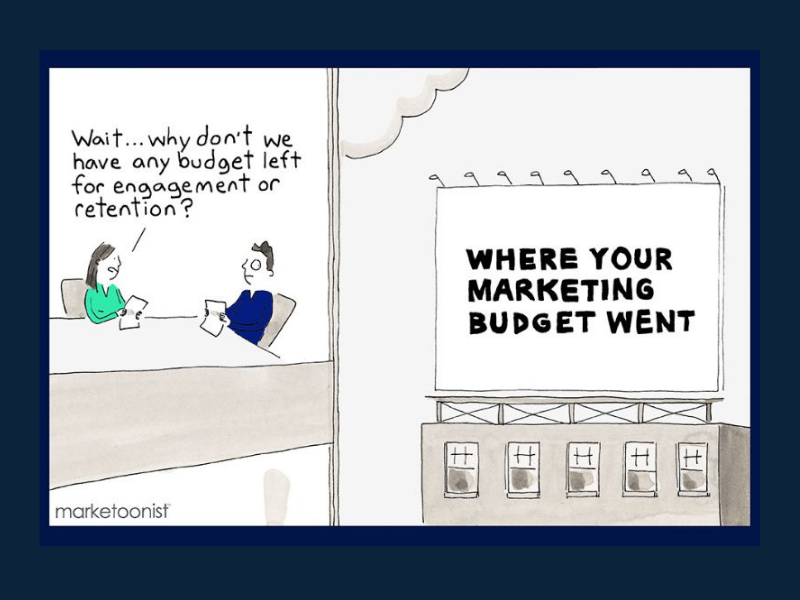
Maybe when you hear the words “marketing budget,” you picture a bunch of line items in a spreadsheet or some big, scary number. In reality, a marketing budget is simply a plan. It’s you deciding, ahead of time, how much you’re willing to invest in growing your business, instead of letting that number be death by a thousand cuts (AKA $5,000 here, $5,000 there).
And while we’re here, let’s clear up a few misconceptions:
It’s not a giant pot of money you dump into ads.
It’s not reserved for “big companies with full marketing teams.”
It’s not meant to box you in or kill your creativity.
A marketing budget is really just a roadmap: how you’re choosing to show up, stay visible, and create demand over the next 12 months. It gives you permission to invest on purpose—in strategy, in content, in design, in tools, in whatever helps your business grow.
When you define your budget, you’re not limiting yourself. You’re giving yourself clarity, boundaries, and a baseline to actually measure success against. Which (I promise) makes everything downstream so much easier. Which leads us to the million dollar question…
How much should small businesses actually budget?
Here’s the part everyone wants a magic number for… and the part where I sadly have to say: it depends. I know, I know. Stay with me.
Most benchmarks land somewhere in the 5–20% of revenue range (Gartner says the average is 7.7%). That’s the classic guideline. But the real question is: What are you trying to achieve this year? Your goals should drive your spend more than a generic industry average.
Here’s an easier way to think about it:
If you want to maintain your current pace → budget on the lower end.
This is for the “keep the lights on” businesses. You’re steady, not chasing aggressive growth, and mainly want to stay visible and consistent. Here, 3-6% of revenue is sustainable.
If you want moderate, steady growth → budget in the middle.
You’re building brand awareness, upleveling content, and running campaigns more intentionally. Think 7–12% of revenue, depending on how ambitious you are.
If you want to grow aggressively → you’re likely in the 13–20% zone.
Unless you’re a startup that’s just received Series A funding and wants to GROW grow, or you’re aggressively chasing a new market, rolling out new products, doing a major brand push, or accelerating demand, you likely don’t fall into this threshold. Here, marketing becomes a real growth engine and requires the investment to match.
No matter where you land, the point isn’t to pick a “perfect” number. It’s to choose a number deliberately, tie it to your goals, and commit to the activities that will support those goals over a full year. Consistency beats one-off splurges every single time.
Industry matters (sometimes more than you think)
Another layer to consider—one that rarely gets talked about—is industry. Two companies with the same revenue and the same growth goals can have wildly different budget needs depending on the competitive landscape they’re operating in.
Some examples:
High-competition industries (think software/SaaS, professional services, ecommerce) often require higher marketing investment because visibility is harder to earn, buying cycles are longer, and differentiation takes real, ongoing effort.
Local service-based businesses (contractors, clinics, trades, real estate teams) can sometimes maintain momentum with lower budgets if they have strong referral networks or recurring client bases, unless they’re pushing for rapid expansion.
Retail, hospitality, and consumer brands usually fall in the middle because they rely heavily on brand-building, consistent content, and ongoing campaigns to stay top-of-mind.
Emerging industries or fast-growth categories (clean tech, AI, health tech, etc.) often require heavier up-front investment to educate buyers, differentiate early, and build trust—especially when the category itself is new.
The point here isn’t to memorize a formula. It’s to recognize that your industry sets the context for what’s realistic. If your competitors are outspending you, outpublishing you, and out-promoting you, even the best strategy will have a hard time keeping pace.
This is why your budget should always be tied to your goals and the reality of the market you’re playing in.
Example marketing budget (for a $10M business)
Let’s take a look at what this might look like in practice, assuming your company made around $10M in revenue last year.
| Growth goal | % of revenue | Annual budget | What this funds |
|---|---|---|---|
| Maintain | 3–6% | $300k–$600k | Consistent content, monthly campaigns, light paid spend, essential tools, basic SEO, and selective outsourced strategy support. |
| Steady growth | 7–12% | $700k–$1.2M | Full content engine, consistent video, multi-channel paid media, ongoing SEO, events/webinars, brand development, and fractional or in-house support. |
| Aggressive growth | 13–20% | $1.3M–$2M | Multi-channel paid campaigns, major brand work, product launches, PR, partnerships, advanced analytics, events, community building, and full creative support. |
If those numbers made your eyes widen a bit, that’s completely normal. Most businesses underestimate how much time, expertise, and ongoing effort it actually takes to market well. But the truth is that marketing works the same way any long-term investment does: you see returns that are directly aligned with the resources you put in. A thoughtful, well-funded and well-resourced program will pay dividends in the long run.
What to include in a simple marketing budget
Your natural next question might be: Okay… but what exactly am I budgeting for? Here’s the short list, AKA the things nearly every small business should have some level of investment in:
Strategy + planning — Your north star. This is the work that makes everything else more efficient and less chaotic. (Think: content strategy, brand messaging, audience research.)
Content creation — Blogs, emails, website updates, thought leadership, video, podcast episodes… whatever helps you stay visible and valuable.
Design + creative — Brand assets, social graphics, landing pages, ad creative. The stuff that makes your business look like it knows what the hell it’s talkin’ about.
Paid media (if you use it) — Google ads, social ads, boosted posts, sponsorships, retargeting campaigns. Paid isn’t mandatory, but if you do it, you need to plan for it.
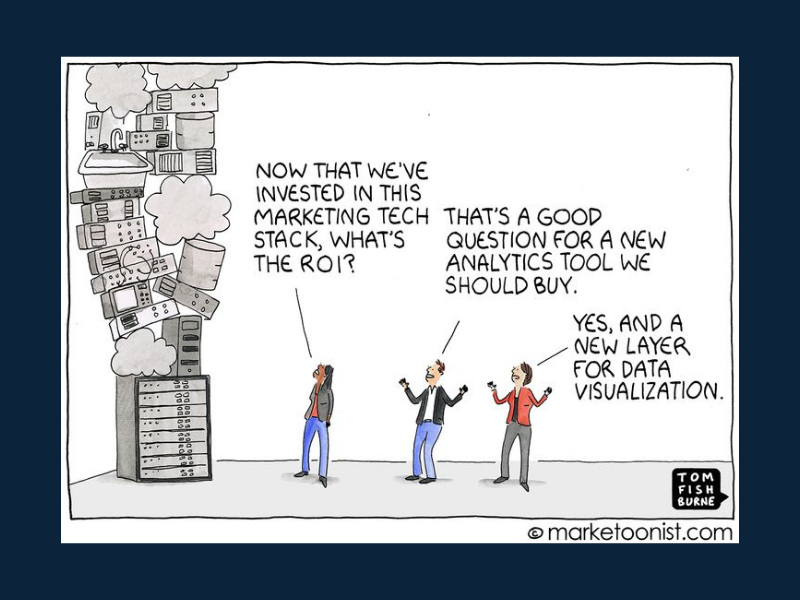
Tools + software — Email platforms, scheduling tools, CRM, analytics, AI tools, project management platforms. Even the “cheap” tools add up over a year.
Website maintenance + SEO — Small updates, optimizations, technical fixes, ongoing improvements… not just the big redesign every 5 years.
Events + community building — This one is SO slept on. Workshops, webinars, conferences, customer events. This is the human, relationship-building side of marketing.
PEOPLE!!!! — Yes, you might have agencies or fractional folks (like me) handling some of the above. But if your goal is to truly grow, you need to think of investing in in-house resources eventually. Your agency and freelance partners will support those people. Marketing is truly a team sport.
This list isn’t exhaustive, and you also don’t need all of these at the same level. The goal here is just to see where your marketing efforts actually live and make sure you’re allocating dollars to the things that move the needle.
How to build your marketing budget in 30 minutes
Let’s keep this simple. You don’t need a finance degree… just a clear goal, a list of priorities, and about half an hour. Here’s where to start:
1. Start with your goals
Are you maintaining, growing, or pushing into aggressive growth? Your goal determines your percentage.
Example goal:
“We want steady growth this year—nothing wild, just consistent demand and better visibility.” → This puts you in the 7–12% of revenue range.
2. List the activities needed to support those goals
Think in categories, not tactics.
Example:
Monthly content (blogs, newsletter)
Quarterly marketing campaigns
Quarterly hosted event or conference sponsorship
Light paid spend
SEO maintenance
CRM + email platform
Design + creative support
Salaries for FTEs
3. Assign rough costs to each item
Ballparks are totally fine—this stage is about definition, not perfection.
Example (ballpark):
Content: $6,000/month
Paid ads: $2,000/month
SEO: $1,000/month
Design: $1,000/month
Tools/software: $1,500/month
Marketing manager (in-house or fractional): $8,000–$12,000/month
Quarterly events: $10,000 each x 4/year
Monthly recurring total: ~$19,500–$23,500
Annual recurring: $234,000–$282,000
Annual events: +$40,000
Total annual estimate: ~$274,000–$322,000
4. Check that against your revenue %
This is the moment where your goals and your numbers have an honest conversation.
If this company does $10M/year, a growth marketing budget would fall between $700k–$1.2M.
Our example budget clocks in between $274-322k/year, which is falling short of that range.
Here’s what that signals:
This business is under-investing for the level of growth it says it wants.
The resources allocated will likely support “baseline visibility,” not meaningful growth. Marketing can absolutely run lean, but not that lean—not if the expectation is predictable, steady growth.
If the business wants stronger pipeline momentum, more brand presence, and better demand generation, the investment will need to increase accordingly.
This step is where companies often experience an “aha” moment: not because the math is surprising, but because it finally aligns growth expectations with what the business is actually fueling marketing with.
5. Spread it across 12 months
Once you’ve landed on your annual number, break it into a monthly view. This is what lets you track budget vs. actuals in real time so you can catch overspending or underspending before it snowballs. This is where the budget becomes genuinely useful (and your finance team will love love love you).
6. Review monthly, adjust quarterly
Just remember that your budget is a living tool, not a contract written in stone. Adjust it as your business evolves, your campaigns perform, and new opportunities come up. Because they will!
Remember—it takes money to make money 🙃
At the end of the day, a marketing budget is going to help you get clearer on what you’re actually trying to accomplish and what’s feasible within your budget. It removes the guesswork, and it gives you structure, accountability, and a way to measure progress without feeling like you’re throwing money spaghetti at the wall.
Start small if you need to. Keep it flexible. But give your marketing folks the resources they need to actually deliver the results you’re hoping for. And as always, we’re here for questions if you have ‘em.
Peace + lurve —