
How to make your brand visible in AI search results
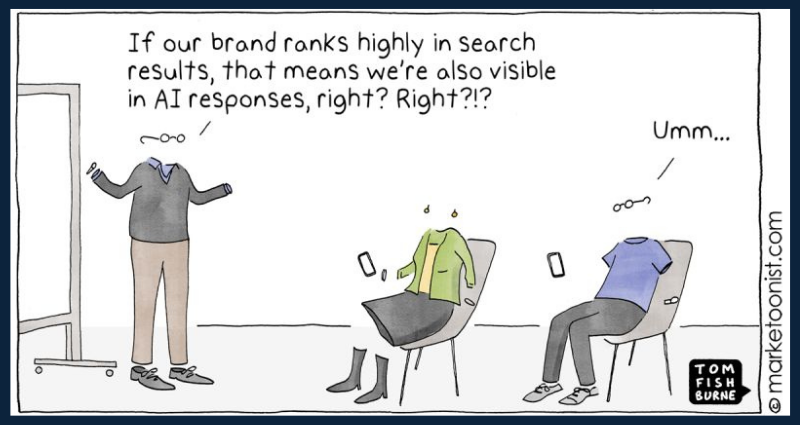
Picture this: a founder in your target market opens ChatGPT, and types “Who’s the best [accounting platform] for mid-sized businesses?”
Is your name on the list?
Now they follow up with “Tell me about [your brand’s name].” What story does the AI search result spit out? Is it your story, told in your words? Orrrr is it a patchwork of old blog posts, a competitor’s comparison page, and that press release you forgot to delete from 2019?
This is literally happening right now, on repeat, with your actual prospects.
According to Forrester’s 2026 Buyers’ Journey Survey of nearly 18,000 global business buyers, generative AI and conversational search now rank as the most meaningful research source for B2B purchase decisions, outranking vendor websites, product experts, and sales reps.
The proportion of buyers using AI during the purchase process grew from 89% in 2025 to 94% in 2026 (Machine Relations Research). And a March 2026 G2 report found that one in three B2B software buyers purchased from a vendor they’d never previously heard of, discovered entirely through an AI recommendation. One in three!
The good news is that there’s a clear framework for showing up and showing up well. But first, it requires understanding that you have two different problems to solve here, and those require diffrerent plays.
PLAY ONE
Getting found when someone asks “Who’s the best at X?”
The first challenge is discovery: AKA, being on the list when a prospect asks an AI to name the top providers in your category. Think of this as the AI equivalent of ranking on page one of Google (traditional SEO), except the stakes are higher because the list is shorter.
A study of nearly 4,000 B2B buyers found that 95% of the time, the winning vendor is already on the buyer’s shortlist before any seller contact, and the pre-contact favourite wins 80% of deals. Being left off the AI’s list could mean you’re disqualified before you had a chance.
How AI decides who to recommend
Here’s something new I learned recently, and is super useful to know.
AI search isn’t one system. Gemini, ChatGPT, and Perplexity each have distinct sourcing preferences, and optimizing for one doesn’t guarantee visibility on the others.
Yext’s analysis of 6.8 million citations across all three platforms found pretty significant divergence in how each model sources information:
Gemini (Google): 52% of citations come from brand-owned websites. It favours structured, factual content directly from your domain, especially pages with schema markup and consistent information across subdomains.
ChatGPT: Trusts what the internet agrees on. It rewards broad distribution and consistency across third-party directories, listings, and review platforms. 65% of ChatGPT’s top-cited pages come from domains with a domain rating of 80 or higher, meaning earned media authority is the dominant citation signal.
Perplexity: Crawls the web in real time and leans into industry-specific directories, community platforms, and reviews. For niche B2B categories, niche sources make up 24% of all citations. Reddit and YouTube are disproportionately represented here.
The headline: brand mentions across the web correlate 3x more strongly with AI visibility than backlinks do (Sapt.ai). So the entire foundation of traditional link-building SEO is being supplemented by something you might call “multi-source brand presence”.
Here’s what that looks like.
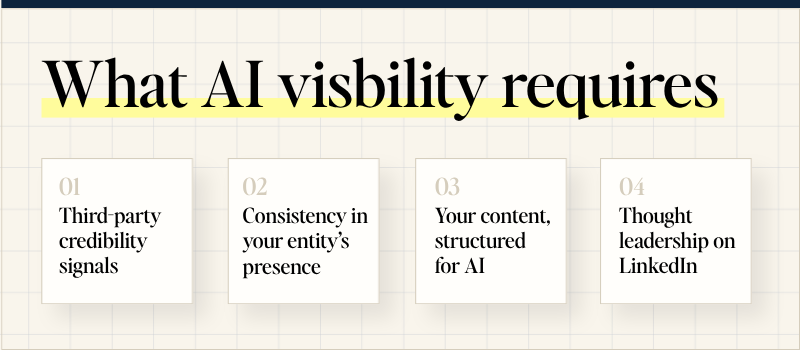
What AI visibility requires
1. Third-party credibility signals
AI systems are looking for the sense that multiple credible, independent sources associate your brand with a specific problem or category. That could mean:
Guest articles or bylines in industry publications
Podcast appearances where your name and area of expertise get mentioned
Being cited in “best of” roundups and comparison pieces
Reviews on platforms like G2, Clutch, or Capterra, especially ones that describe what you do in natural language (these are huge if you’re in the B2B tech space)
Mentions in LinkedIn articles and/or community discussions in your space
2. Consistent entity presence
AI models build an understanding of your brand as an “entity” that’s recognizable, and so much like traditional SEO, inconsistencies across platforms will confused the AI engine.
Your brand name, company description, category, location, and contact info should be identical across your website, LinkedIn, Crunchbase, Google Business Profile, and any and all relevant directories. Yes, it’s boring to check these all… but unfortunately it really matters.
3. Your own content, structured for AI
Traditional SEO wisdom still applies here when writing new web and blog content: answer-first structure, FAQ formatting, clear headers, schema markup. The difference is it’s no longer about “how do I rank for this keyword?” It’s about “when someone describes their problem, will AI associate me with the solution?”
Practically speaking, try to write content that directly and explicitly answers the questions your buyers ask, including “who is the best [X] for [Y type of company]?” Don’t make AI guess!
4. Founder thought leadership on LinkedIn
If you’re one of our clients that hates posting on LinkedIn, I’m calling you out here!
AI systems with real-time web access (Perplexity, especially) index LinkedIn content. A founder who posts consistently about a specific problem space, in a specific voice, with a clear point of view, is actively shaping what AI learns to associate with their name and brand.
PLAY TWO
Controlling the narrative when someone asks “What should I know about [your brand]?”
So our first problem was about showing up on a list of providers along with your competitors. Now our second challenge is controlling what the AI says when someone asks specifically about your brand.
When a prospect asks an AI about your company, it synthesizes whatever the public web says about you. Here’s the uncomfortable part:
According to the AirOps 2026 State of AI Search report, 85% of brand mentions in AI-generated answers come from external third-party domains. Only 15% come from brands’ own websites.
So if your website has outdated positioning, contradictory information, or gaps, the AI fills those gaps with whatever else it can find, like a competitor’s comparison page, a stale review, or a product announcement from lifetimes ago.
And there are consequences to that old info. Pages not updated quarterly are 3x more likely to lose citation visibility. More than 70% of all pages cited by AI have been updated within the past 12 months (AirOps 2026 State of AI Search). So stale content is not just underperforming but actively handing your narrative to other areas of the internet not within your control.
The narrative control playbook
1. Audit and delete outdated content
This is the most actionable step and easy to start on today. Go through your blog, press releases, case studies, and service pages and ask: does this still represent us accurately? Because old content that misrepresents your positioning is being actively used by AI to describe you.
2. Keep your core pages fresh and consistent
Your About page, homepage, and service pages are disproportionately influential. Yoast’s analysis found these are often the first things AI models latch onto, so they need to reflect today’s positioning, not two years ago’s. Treat them as living documents, not set-it-and-forget-it pages.
If your homepage says one thing and your LinkedIn says another and your Clutch profile says a third, AI systems will surface that.
3. Own the comparison narrative
This is one of the most slept on plays in B2B content, IMO! Write directly about how you compare to alternatives. If you don’t publish anything that addresses “[Your Brand] vs. [Competitor]” or “Why founders choose [Your Brand] over hiring in-house,” AI will synthesize that comparison from whoever has written about it. Almost certainly a competitor or a third-party review site.
Be the primary source on your own positioning. Talk explicitly about pricing approach, service scope, and who you’re not right for. Directness signals authority, while vagueness creates a vacuum, and nature (and AI) loathes a vacuum.
4. Respond to and encourage reviews
Negative reviews carry particular weight in AI narratives. Research on B2B supplier selection found that 69% of buyers would avoid a supplier based on negative reviews AI surfaces (Trax Tech). Actively encouraging satisfied clients to leave detailed, outcome-specific reviews on relevant platforms is both a reputation play and a narrative control play. Two birds, one stone.
5. Monitor for “sentiment drift”
Because AI models rely on historical data, they can surface outdated narratives that no longer reflect your current positioning. A company that pivoted its service model two years ago might still be described in the old terms, simply because older content has more accumulated weight in training data.
Monitor what AI says about your brand by regularly querying ChatGPT, Perplexity, and Google’s AI Overview with your own brand name. Treat what you find as market intelligence, then go fix the source of the problem.
Where to start with AI visibility
If you’re feeling a bit overwhelmed, fair. Honestly just writing this has made me realize how much work we have yet to do at Outspoke! But here’s a prioritized sequence that will help you take the first steps:
Run your own AI audit. Open ChatGPT, Perplexity, and Google and search for your category (“best [X] for [Y]”) and your brand name directly. Screenshot what comes up. This is your baseline.
Do a content audit for deletion. Identify any pages, posts, or press releases that misrepresent your current positioning and remove or update them.
Refresh your core pages. Homepage, About, and Services should reflect your current positioning precisely and consistently across every platform.
Write the comparison content. Own the narrative around how you’re different, who you’re for, and what working with you looks like versus the alternatives.
Build your third-party presence. One well-placed byline, podcast appearance, or roundup mention does more for your AI discovery than ten more blog posts on your own site.
Post consistently as a founder. LinkedIn content is increasingly indexed by AI. Your voice and perspective are part of your brand’s discoverability, whether you treat it that way or not.
The window to get ahead of this is now, because AI search is already here and most of your competitors haven’t even started to adapt. Only 22% of marketers currently track AI visibility and only 25.7% plan to develop content specifically for AI citations. That gap means that just by reading this article, you’re already ahead!
Own the narrative, or the rest of the web will own it for you.
Rosalind Toews is the founder of Outspoke, a B2B content marketing and brand strategy agency for tech and professional services founders. Outspoke helps clients build brand authority that shows up everywhere their buyers are looking.