
The B2B brand identity crisis (and 6 mistakes behind it)
Here’s a little exercise. Open a few competitor websites in your industry. Read their homepages, scroll through their LinkedIn feeds, and take a look at their latest blog posts.
Starting to notice a pattern?
Everyone’s “innovative.”
Everyone’s “customer-centric.”
Everyone’s “transforming the way businesses operate.”
Now, here’s an interesting question. If you removed your company’s name and logo from your marketing, could one of your competitors publish it without changing much?
If the answer is yes, you’re certainly not alone. According to Wynter’s 2026 B2B Vendor Differentiation Survey, 64% of surveyed B2B SaaS marketing leaders found it difficult to distinguish competing vendors based on their websites and messaging.
In B2B, where purchasing decisions can take months (sometimes years), building brand recognition helps keep your business top of mind so that when buyers are ready to make a purchase, you’re one of the first they think of.
Yet it’s surprisingly easy to fall into familiar marketing habits, especially when you’re balancing credibility, complex offerings, and pressure to keep producing content.
Here are six common B2B marketing mistakes that can make your brand harder to remember, plus what you can do about them.
1. Playing it so safe that your brand has no personality
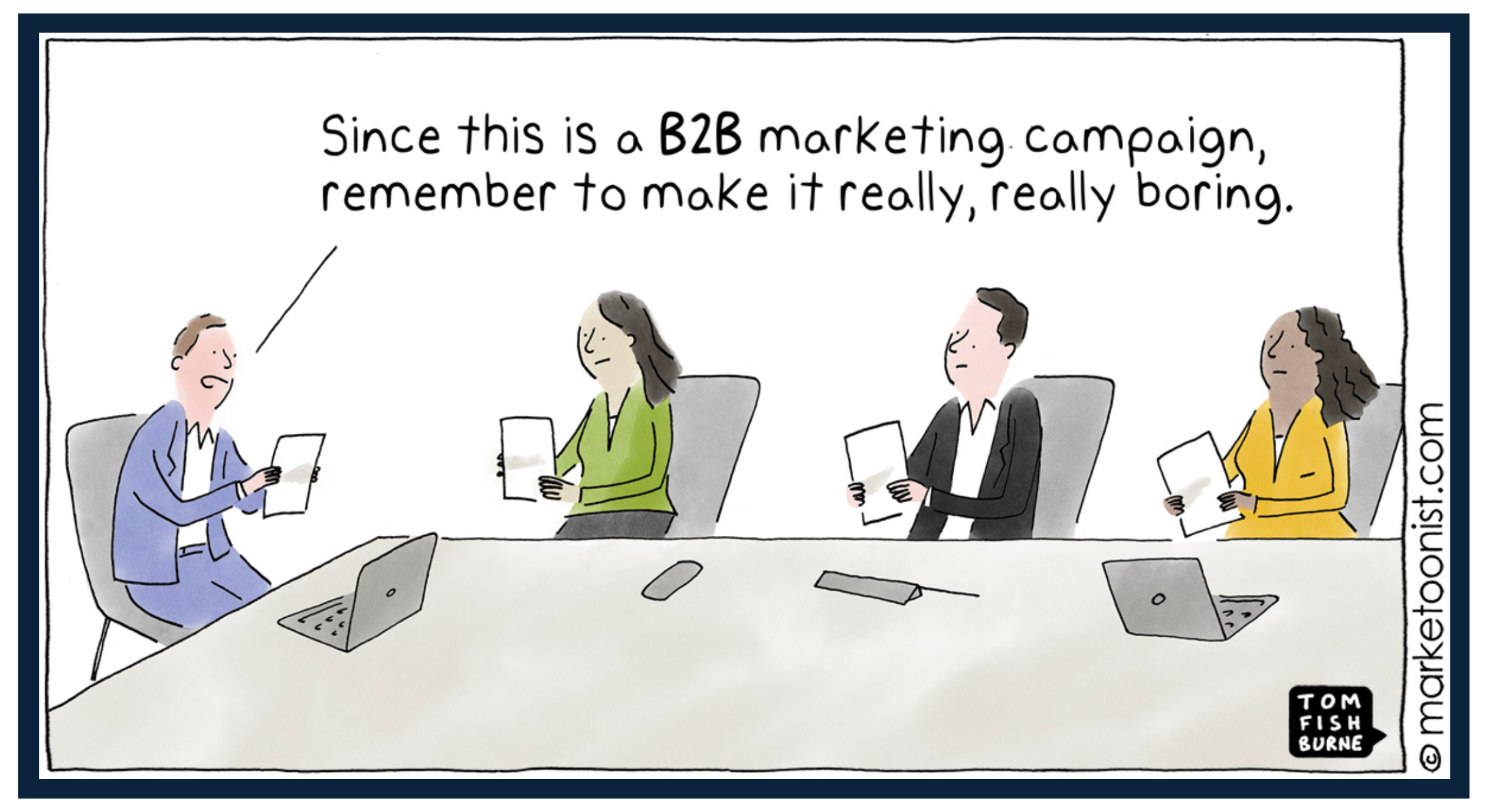
Somewhere along the way, B2B marketing developed a reputation for being a little… corporate.
You know the language. “We leverage cutting-edge solutions to drive operational excellence and deliver exceptional value.”
It’s easy to understand why businesses default to it. When you’re selling complex technology or professional services, you want to sound credible. And when messaging needs multiple rounds of approval, playing it safe can feel sensible.
But when everyone uses similar language and promises, customers have a harder time distinguishing one business from another.
What to do instead: Give your brand a recognizable voice
Your brand voice should reflect the people and personality behind your business. And no, that doesn’t mean every B2B company needs to start cracking jokes on LinkedIn.
A distinctive brand voice can be authoritative, conversational, playful, or straightforward. What matters is that it reflects your business’s personality and resonates with the people you’re trying to reach.
Pay attention to how your team communicates naturally with customers. What phrases do they use? How do they explain complicated ideas? How do they make customers feel? Use those observations to develop practical writing guidelines, with examples of how your voice sounds across different channels.
The goal is to build a brand people recognize even when your logo isn’t doing the heavy lifting.
2. Publishing thought leadership without any original thoughts
Ah, thought leadership. One of the most popular terms in B2B marketing.
And for good reason. Sharing expertise helps businesses build credibility and gives potential customers a reason to trust them. And with AI making it easier than ever to produce content, original perspectives are becoming even more valuable.
But as more businesses invest in thought leadership, there’s also a lot of content covering familiar ground. Another article about five trends shaping your industry. Another LinkedIn post explaining why digital transformation matters. Another roundup of best practices readers have encountered a dozen times before.
Educational content has its place, but original perspectives give people a stronger reason to remember who shared them. They can also influence purchasing decisions. In 2025, Edelman found that 79% of surveyed decision-makers were more likely to advocate for a company’s proposal if it consistently produced high-quality thought leadership.
What to do instead: Get your experts talking
Chances are, some of your best content ideas are sitting in the heads of people across your organization.
Your founder has opinions about where the industry is heading. Your sales team knows which questions prospects keep asking. Your technical experts have seen what works, what fails, and what customers misunderstand.
Instead of asking them to review finished content, interview them before you start writing. Try questions like:
- What advice in our industry do you disagree with?
- What’s something customers consistently misunderstand?
- What have you changed your mind about after years of experience?
A 30-minute conversation can uncover ideas for blogs, LinkedIn posts, webinars, and more.
Your competitors can cover the same industry trends, but your team’s experiences are harder to replicate.
3. Letting AI do all the strategic thinking
We love a good AI shortcut. Give us a tool that makes research, content production, or administrative work easier, and we’re listening. But there’s a growing temptation to hand over the entire marketing strategy to ChatGPT and call it a day.
Ask AI to create a B2B marketing strategy, and you’ll probably get reasonable recommendations. Build thought leadership. Post consistently on LinkedIn. Create educational content. Launch an email newsletter.
All perfectly valid recommendations. The problem is, AI could give that exact same strategy to hundreds of other businesses in your industry.
Without a clear understanding of your customers, your business, and what makes you different, AI tends to default to familiar ideas and approaches. And when everyone follows the same playbook, everyone starts sounding pretty much the same.
What to do instead: Keep humans in charge of the thinking
Before developing your next marketing campaign, get clear on who you’re trying to influence, what problems your customers are trying to solve, and what makes your business different. AI is great at making assumptions about an audience, so one super simple thing you can do is your own first-party research: talk to your ideal customer.
And once you’ve gathered real intelligence from the people who matter most (customers), bring in perspectives from your leadership team, salespeople, and customer-facing employees. Their knowledge and experience can help shape a strategy that’s specific to your business and the people you want to reach.
Then, and only then, should you use AI to help bring those ideas to life—whether that’s exploring creative directions, organizing research, or speeding up content production.
4. Trying to appeal to absolutely everyone
“We work with businesses of all sizes, across all industries, to deliver customized solutions that meet their unique needs.”
This kind of positioning usually comes from a reasonable place. Growing businesses don’t want to turn away potential customers, so they keep their messaging broad enough to accommodate every opportunity.
The trouble is, when you’re trying to speak to everyone, your ideal customers can have a harder time recognizing that you’re particularly well suited to them.
What to do instead: Get specific about who you’re speaking to
Imagine two hypothetical IT consulting firms. One promises comprehensive technology solutions for businesses of all sizes. The other helps growing professional services firms modernize outdated systems without disrupting day-to-day operations.
If you’re the COO of a local accounting firm dealing with aging technology, which one sounds more relevant?
That’s what clear positioning can do.
Start by understanding which customers you’re best positioned to serve. Look beyond job titles to understand their challenges, buying triggers, and decision criteria. Talk to your sales team, interview customers, and use those insights to shape your messaging and content.
You don’t necessarily need to narrow your business to one industry. But you should make deliberate choices about which audiences and problems your marketing prioritizes.
5. Telling customers you’re different without showing them
“We’re a trusted partner.”
“We deliver exceptional results.”
“Our customer-centric approach sets us apart.”
Sound familiar? These are all qualities businesses want to be known for. And they might be completely true. But when every company makes similar claims, prospective customers need something more concrete to believe them.
What to do instead: Back up your claims with proof
Think about the claims you make most often in your marketing. What evidence do you have to back them up?
If you say you’re a trusted partner, show the companies that choose to work with you. If you promise exceptional results, share case studies that demonstrate the impact of your work. If customer service is your biggest differentiator, let your customers explain what it’s like to work with you.
Testimonials, customer stories, case studies, recognizable client logos, and relevant results all help strengthen your brand differentiation by giving prospective buyers evidence of what sets you apart.
And you don’t need an impressive collection of awards or a library of polished case studies to get started. Sometimes a specific customer quote or a short story about a problem you’ve helped solve can go a long way.
The goal is to give buyers a reason to believe what you’re telling them.
6. Creating content without considering what your audience cares about
It’s easy for B2B marketing to become a steady stream of company updates, industry news, and content about your products or services. And while there’s a place for all of those things, it’s worth asking how much of it your prospective customers are interested in.
Your audience is busy. They’re navigating business challenges, evaluating priorities, and trying to make better decisions. If your content doesn’t speak to those interests, it’s going to have a harder time earning their attention, regardless of how consistently you publish.
What to do instead: Give your audience a reason to pay attention
When evaluating the content your business is putting out, ask three questions:
- Why would our audience care? Does this address something they’re trying to understand or solve?
- What are we contributing? Do we have an original observation, example, or perspective?
- Why should this come from us? What makes our business particularly well suited to tell this story?
Look for opportunities to share customer insights, original research, industry perspectives, or stories from your team’s experience. The best ideas often come from understanding what your customers are dealing with, rather than simply looking for something new to publish.
Consistency matters, but giving people a reason to pay attention is what makes that consistency worthwhile.
How to tell if your brand is becoming forgettable
Before you panic and start planning a complete rebrand (please don’t), take a closer look at these six areas of your marketing:
- Differentiation: Could a competitor make the same claims we’re making about our business?
- Positioning: Can prospective customers quickly understand who we help and why they should choose us?
- Perspective: Are we sharing ideas and expertise that customers wouldn’t get from just any competitor?
- Credibility: Are we backing up our claims with customer stories, results, and other evidence?
- Relevance: Does our marketing speak to the challenges and priorities of the customers we want to reach?
- Recognition: Are we building a consistent, recognizable brand across our marketing?
You don’t need perfect answers to every question. Start with the areas where you see the biggest gaps, whether that’s clearer positioning, stronger proof of your expertise, or a more distinctive brand voice.
Then look for signs that your marketing is resonating with the right people. Are prospective customers familiar with your business before speaking to sales? Are they referencing your content or demonstrating a clearer understanding of what you offer? These are some of the signals worth paying attention to when measuring brand marketing performance.
Give people something worth remembering
Building a distinctive B2B brand comes down to understanding your customers, having a clear perspective, and consistently showing what makes your business worth choosing.
The good news? You probably already have plenty of what makes your business different. It’s in your people, experiences, opinions, and customer relationships. The opportunity is to bring more of that into how you talk about your business.
If you’re looking for an outside perspective on making your B2B brand more memorable, let’s talk.